I’ve Never Seen An Aca Penalty Caused By Bad Intentions
A business owner said something to me recently that I’ve heard more times than I can count. He leaned back in his chair, crossed his arms, and said:
“We should be okay. I think payroll handles all of that.”
I didn’t answer right away. It wasn’t the word “payroll” that caught my attention. It was the word “think.”
In my decades of experience helping companies navigate health insurance and compliance, I’ve never seen an Affordable Care Act (ACA) penalty caused by bad intentions.
I have, however, seen plenty caused by assumptions.
The Compliance Game of “Hot Potato”
When it comes to tracking full-time employee counts and health coverage offer data, companies often accidentally create an invisible game of hot potato:
-
The executive assumes payroll has the right data.
-
Payroll assumes the HR system is up to date.
-
HR assumes the benefits platform is accurate.
-
The broker assumes the information they receive is correct.
-
The carrier reports exactly what they are given.
For months, everything appears to be working beautifully. There are no alarms. No warning signs.
Then one day, an IRS letter arrives. Suddenly, the conversation completely changes from comfortable assumptions to finger-pointing:
-
“Who was responsible for this?” * “How did we miss it?”
-
“Why didn’t anyone catch it?”
Where ACA Penalties Really Come From
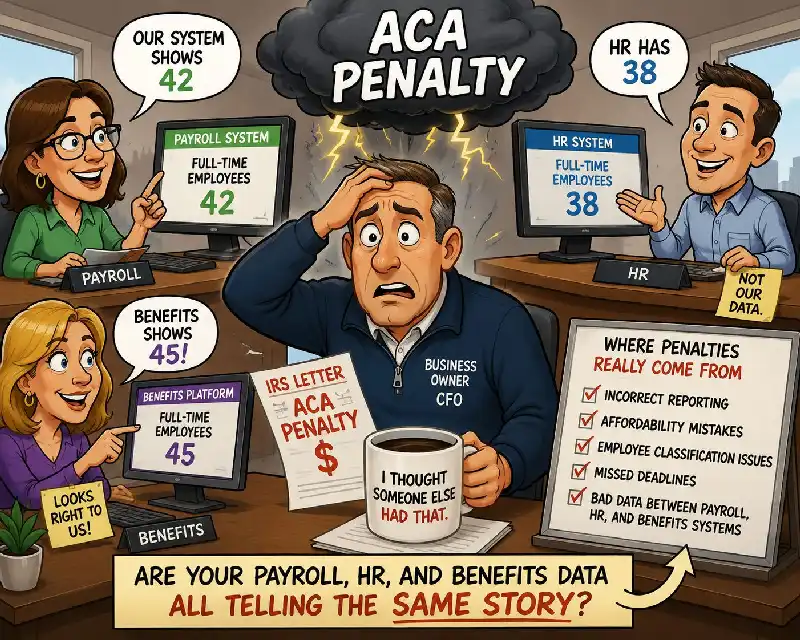
The truth is, ACA penalties rarely stem from one catastrophic mistake. They are almost always the result of several small, quiet systemic gaps.
| The Small Mistakes | The Costly Consequences |
| Data Mismatches | Payroll, HR, and Benefits software aren’t syncing properly, showing completely different employee counts. |
| Classification Errors | An employee is classified incorrectly (variable hour vs. full-time). |
| Math Mistakes | An affordability calculation is off by just a few dollars. |
| Reporting Gaps | A new hire isn’t reported on time, or an IRS deadline quietly slips by. |
None of these mistakes seem significant on their own. But when stacked together, they become a incredibly expensive lesson.
Clarity Trumps Technology
The companies I see with the fewest ACA issues aren’t necessarily using the newest AI-driven HR software or the most expensive benefits platforms. They simply don’t rely on assumptions. They have a documented process. They manually reconcile their data. And most importantly, everyone knows who is responsible for making sure payroll, HR, and benefits are telling the exact same story.
That is what gives business owners true confidence—not the technology they buy, but the clarity of their operations.
A Question for Your Leadership Team:
If someone asked today, “Who owns ACA compliance in your organization?” would there be one clear answer?
If you’re not entirely sure, that’s a conversation worth having with an expert before the IRS starts asking the exact same question.
Let’s ensure your systems are actually talking to one another. Reach out to our team at ShopBenefits today for a data and compliance review.
Al Schiebel 📧 al@shopbenefits.com
📞 404-256-2171
An Oakbridge Insurance Agency partner